

Tejase Technologies has multiple openings for Sr. Programmer/Business Systems Analysts and Sr. Software Engineers. These positions require either Bachelors or Masters degrees with five years or six months experience respectively. We will accept US equivalent degrees. Must be willing to travel and/or relocate. Mail to: Tejase Technologies Inc, 950 Office Park Road, #202, West Des Moines, IA 50265. EOE.


Click Here for the Tejase Software Development Process Flow Chart
Microsoft .NET
Microsoft .NET Framework was designed with several  intentions:
-
Interoperability - Because interaction between new and older applications is commonly required, the .NET Framework provides means to access functionality that is implemented in programs that execute outside the .NET environment. Access to COM components is provided in the System.Runtime.InteropServices and System.EnterpriseServices namespaces of the framework, and access to other functionality is provided using the P/Invoke feature.
-
Common Runtime Engine - Programming languages on the .NET Framework compile into an intermediate language known as the Common Intermediate Language, or CIL (formerly known as Microsoft Intermediate Language, or MSIL). In Microsoft's implementation, this intermediate language is not interpreted, but rather compiled in a manner known as just-in-time compilation (JIT) into native code. The combination of these concepts is called the Common Language Infrastructure (CLI), a specification; Microsoft's implementation of the CLI is known as the Common Language Runtime (CLR).

Our methodology contains everything you need to be successful – identified and prioritized tasks, clearly defined roles and responsibilities, deliverable descriptions, prototypes, templates and examples.




 We're glad that you're here! Since IT staffing is an essential part of our business, we are always looking for qualified candidates to fill positions.
-
Language Independence - The .NET Framework introduces a Common Type System, or CTS. The CTS specification defines all possible datatypes and programming constructs supported by the CLR and how they may or may not interact with each other. Because of this feature, the .NET Framework supports development in multiple programming languages. This is discussed in more detail in Microsoft .NET Languages.
-
Base Class Library - The Base Class Library (BCL), part of the Framework Class Library (FCL), is a library of types available to all languages using the .NET Framework. The BCL provides classes which encapsulate a number of common functions, including file reading and writing, graphic rendering,
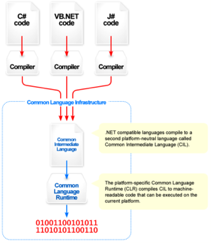 database interaction and XML document manipulation.
 -
Simplified Deployment - >Installation of computer software must be carefully managed to ensure that it does not interfere with previously installed software, and that it conforms to increasingly stringent security requirements. The .NET framework includes design features and tools that help address these requirements.
-
Security - .NET allows for code to be run with different trust levels without the use of a separate sandbox.
A design goal of the .NET Framework was to support platform independence[citation needed]. That is, a program written to use the framework should run without change on any type of computer for which the framework is implemented. However, Microsoft has only implemented the full .NET framework on the Windows operating system. Microsoft and others have implemented portions of the framework on non-Windows systems, but to date these implementations are neither complete nor widely used, so full cross-platform support has not been achieved.
.NET Framework architecture
Data warehousing
Data warehousing is combining data from multiple and usually varied sources into one comprehensive and easily manipulated database. Common accessing systems of data warehousing include queries, analysis and reporting. Because data warehousing creates one database in the end, the number of sources can be anything you want it to be, provided that the system can handle the volume, of course. The final result, however, is homogeneous data, which can be more easily manipulated.
Data warehousing is commonly used by companies to analyze trends over time. In other words, companies may very well use data warehousing to view day-to-day operations, but its primary function is facilitating strategic planning resulting from long-term data overviews. From such overviews, business models, forecasts, and other reports and projections can be made. Routinely, because the data stored in data warehouses is intended to provide more overview-like reporting, the data is read-only. If you want to update the data stored via data warehousing, you'll need to build a new query when you're done.
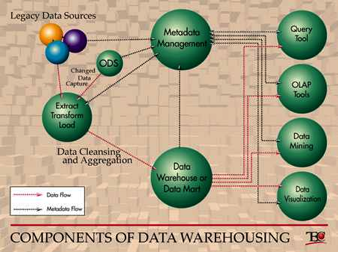 This is not to say that data warehousing involves data that is never updated. On the contrary, the data stored in data warehouses is updated all the time. It's the reporting and the analysis that take more of a long-term view.
Data warehousing is not the be-all and end-all for storing all of a company's data. Rather, data warehousing is used to house the necessary data for specific analysis. More comprehensive data storage requires different capacities that are more static and less easily manipulated than those used for data warehousing.
Data warehousing is typically used by larger companies analyzing larger sets of data for enterprise purposes. Smaller companies wishing to analyze just one subject, for example, usually access data marts, which are much more specific and targeted in their storage and reporting. Data warehousing often includes smaller amounts of data grouped into data marts. In this way, a larger company might have at its disposal both data warehousing and data marts, allowing users to choose the source and functionality depending on current needs.
 |
 |
 |
Software Testing
Software testing is the process used to measure the quality of developed computer software. Usually, quality is constrained to such topics as correctness, completeness, security, but can also include more technical requirements as described under the ISO standard ISO 9126, such as capability, reliability, efficiency, portability, maintainability, compatibility, and usability. Testing is a process of technical investigation, performed on behalf of stakeholders, that is intended to reveal quality-related information about the product with respect to the context in which it is intended to operate. This includes, but is not limited to, the process of executing a program or application with the intent of finding errors. Quality is not an absolute; it is value to some person. With that in mind, testing can never completely establish the correctness of arbitrary computer software; testing furnishes a criticism or comparison that compares the state and behaviour of the product against a specification. An important point is that software testing should be distinguished from the separate discipline of Software Quality Assurance (SQA), which encompasses all business process areas, not just testing.
Today, software has grown in complexity and size. The software product developed by a developer is according to the System Requirement Specification. Every software product has a target audience. For example, a video game software has its audience completely different from banking software. Therefore, when an organization invests large sums in making a software product, it must ensure that the software product must be acceptable to the end users or its target audience. This is where Software Testing comes into play. Software testing is not merely finding defects or bugs in the software; it is the completely dedicated discipline of evaluating the quality of the software.
There are many approaches to software testing, but effective testing of complex products is essentially a process of investigation, not merely a matter of creating and following routine procedure. One definition of testing is "the process of questioning a product in order to evaluate it", where the "questions" are operations the tester attempts to execute with the product, and the product answers with its behavior in reaction to the probing of the tester. Although most of the intellectual processes of testing are nearly identical to that of review or inspection, the word testing is also used to connote the dynamic analysis of the product—putting the product through its paces. Sometimes one therefore refers to reviews, walkthroughs or inspections as "static testing", whereas actually running the program with a given set of test cases in a given development stage is often referred to as "dynamic testing", to emphasize the fact that formal review processes form part of the overall testing scope.
-
Unit testing tests the minimal software component, or module. Each unit (basic component) of the software is tested to verify that the detailed design for the unit has been correctly implemented. In an Object-oriented environment, this is usually at the class level, and the minimal unit tests include the constructors and destructors.
-
Integration testing exposes defects in the interfaces and interaction between integrated components (modules). Progressively larger groups of tested software components corresponding to elements of the architectural design are integrated and tested until the software works as a system.
-
Functional testing tests at any level (class, module, interface, or system) for proper functionality as defined in the specification.
-
System testing tests a completely integrated system to verify that it meets its requirements.
-
System integration testing verifies that a system is integrated to any external or third party systems defined in the system requirements.
-
Acceptance testing can be conducted by the end-user, customer, or client to validate whether or not to accept the product. Acceptance testing may be performed as part of the hand-off process between any two phases of development. See also Development stage
- Alpha testing is simulated or actual operational testing by potential users/customers or an independent test team at the developers' site. Alpha testing is often employed for off-the-shelf software as a form of internal acceptance testing, before the software goes to beta testing.
- Beta testing comes after alpha testing. Versions of the software, known as beta versions, are released to a limited audience outside of the company. The software is released to groups of people so that further testing can ensure the product has few faults or bugs. Sometimes, beta versions are made available to the open public to increase the feedback field to a maximal number of future users.
It should be noted that although both Alpha and Beta are referred to as testing it is in fact use immersio n. The rigors that are applied are often unsystematic and many of the basic tenets of testing process are not used. The Alpha and Beta period provides insight into environmental and utilization conditions that can impact the software.
After modifying software, either for a change in functionality or to fix defects, a regression test re-runs previously passing tests on the modified software to ensure that the modifications haven't unintentionally caused a regression of previous functionality. Regression testing can be performed at any or all of the above test levels. These regression tests are often automated.
Java
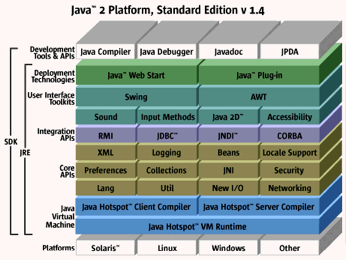
 was designed to have the "look and feel" of the C++ language, but it is simpler to use than C++ and enforces an object-oriented programming model. Java can be used to create complete applications that may run on a single computer or be distributed among servers and clients in a network. It can also be used to build a small application module or applet for use as part of a Web page. Applets make it possible for a Web page user to interact with the page.
 The major characteristics of Java are:
-
The programs you create are portable in a network. (See portability.) Your source program is compiled into what Java calls bytecode, which can be run anywhere in a network on a server or client that has a Java virtual machine. The Java virtual machine interprets the bytecode into code that will run on the real computer hardware. This means that individual computer platform differences such as instruction lengths can be recognized and accommodated locally just as the program is being executed. Platform-specific versions of your program are no longer needed.
-
The code is robust, here meaning that, unlike programs written in C++ and perhaps some other languages, the Java objects can contain no references to data external to themselves or other known objects. This ensures that an instruction can not contain the address of data storage in another application or in the operating system itself, either of which would cause the program and perhaps the operating system itself to terminate or "crash." The Java virtual machine makes a number of checks on each object to ensure integrity.
-
Java is object-oriented, which means that, among other characteristics, an object can take advantage of being part of a class of objects and inherit code that is common to the class. Objects are thought of as "nouns" that a user might relate to rather than the traditional procedural "verbs." A method can be thought of as one of the object's capabilities or behaviors.
-
In addition to being executed at the client rather than the server, a Java applet has other characteristics designed to make it run fast.
-
Relative to C++, Java is easier to learn. (However, it is not a language you'll pick up in an evening!)
Java was introduced by Sun Microsystems in 1995 and instantly created a new sense of the interactive possibilities of the Web. Both of the major Web browsers include a Java virtual machine. Almost all major operating system developers (IBM, Microsoft, and others) have added Java compilers as part of their product offerings.
The Java virtual machine includes an optional just-in-time compiler that dynamically compiles bytecode into executable code as an alternative to interpreting one bytecode instruction at a time. In many cases, the dynamic JIT compilation is faster than the virtual machine interpretation.
JavaScript should not be confused with Java. JavaScript, which originated at Netscape, is interpreted at a higher level, is easier to learn than Java, but lacks some of the portability of Java and the speed of bytecode. Because Java applets will run on almost any operating system without requiring recompilation and because Java has no operating system-unique extensions or variations, Java is generally regarded as the most strategic language in which to develop applications for the Web. (However, JavaScript can be useful for very small applications that run on the Web client or server.)






2007 © Copyright Tejase Technologies | Contact webmaster | Website created by The Grand Design